
Sources for Pleasant Grove Past Residents
Each source covers a different era or relationship to an address. The Recorder’s official land-record description begins in 1870. Handwritten and typed indexes bridge the early period before computerized records. The abstract route is strongest for recorded property parties. Directories and newspapers are better for household or published-presence clues. Sanborn maps show structures and street context, not a list of residents.
| Source | Years or span | Where held | What it shows |
|---|---|---|---|
| County land records | 1870-present; computerized overlap later | Utah County Recorder | Recorded parties, instruments, dates |
| Recorder index transition | Handwritten through Jan. 1978; overlap to 1985 | County Land Records / office | Older names and abstract trail |
| Utah city directories | 1973 inclusion lead, exact run unverified | Marriott Library | Name/address snapshot |
| Sanborn maps | 1890; related 1907, 1917, 1931 | LOC | Structures and street layout |
| Newspapers and Archives | Historical, date varies | Digital Newspapers | Published events, names, places |
The exact first and last Pleasant Grove city-directory years, verified reverse-directory run, and some local obituary coverage remain research gaps. Ask the library or repository for the item-level catalog record rather than filling an absent year with an estimate.
Begin Pleasant Grove Address History
For a known address, search the Utah County address route if available. The direct form timed out during inspection, so GIS address search is the verified fallback. Confirm the parcel, copy its serial, and use the serial in property and abstract routes. The county accepts formats such as 411750010, 41:175:10, and 41 175 10.
Do not guess a serial from a tax description. Keep the printed street line, county situs, mailing line, postal city, ZIP, subdivision, lot, and legal description separate. A serial remains the stable bridge even when a mailing address changes. The map can confirm the parcel shape, but the map’s historic date is not the recording date of a deed.
When an abstract row names a person, record the role. Grantor means the transferring party. Grantee means the receiving party. An HOA, lender, easement holder, plat filer, or trustee is not automatically a household member. This distinction is the foundation of a careful previous-residents search.
Follow the Pleasant Grove Deed Chain
The deed chain is an ordered series of recorded instruments tied to a parcel. It can show ownership history, but it does not prove who occupied a home. Inspected abstracts show owner and mailing lines, taxing description, grantor, grantee, comments, entry number, book/page, instrument type, recording date and time, consideration, satisfaction, and tie entries. A recorded consideration field is not a market-value opinion.
- Open the parcel view and capture the serial, property line, mailing line, and map date.
- Open the abstract and start with the newest relevant deed row.
- Separate deed, plat, HOA, easement, trust-deed, satisfaction, and lender entries.
- Follow entry numbers or related serials backward, opening an image where the portal offers one.
- Compare each named owner with a dated directory, newspaper, census, obituary, or cemetery clue before calling that person a past household.
- Chain of title
- The sequence of recorded transfers and related instruments for a parcel.
- Legal description
- The recorded property description, which may be a plat/lot or metes-and-bounds text.
- Grantor
- The transferring party named in an instrument.
- Grantee
- The receiving party named in an instrument.
The county Recorder cautions that it does not perform title searches or offer legal advice. A previous-residents narrative should describe an evidence chain, not promise a complete list.
Pleasant Grove Liberty Grove Pattern
An inspected Liberty Grove PUD abstract with serial 45:237:0029 shows why document types matter. Plat, HOA, easement, deed, trust-deed, lender, and related entry rows can share a parcel timeline. A person named in one row may hold an interest, sign a document, or represent an organization. The abstract does not say that every party lived at the address.
This local pattern is useful for previous residents because it gives a route from the current parcel to older instruments without exposing a household roster. Use the subdivision or plat name to locate the map, then compare the parcel view and historic date. If an HOA appears, the Utah Commerce HOA Registry can identify a legal association name, but no public membership directory was located.
Property Watch can alert a subscriber after processed recordings for a known serial or name/business. It is free, but the county says alerts can miss applicable recordings and are not legal advice or a guarantee against fraud. Treat it as a safety aid, not a complete ownership history.
The Utah County party-name search is a companion route for the document-role method.
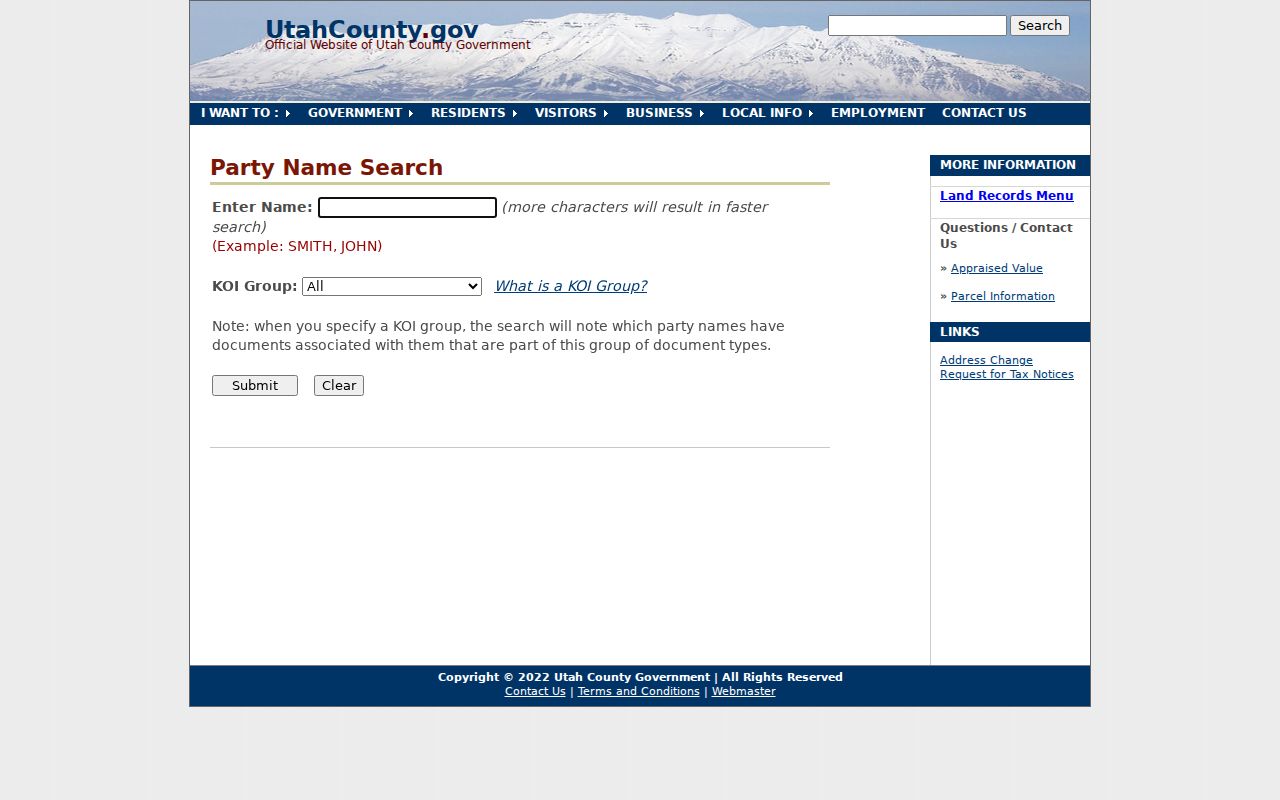
The image supports a dated party search, but a named party still needs an occupancy source before being called a past household.
Pleasant Grove Directory Years
Directories fill the space between larger census intervals. A city directory can give a name, address, occupation, spouse note, or owner and renter mark. A census can provide a household snapshot for its own date. A newspaper can confirm an event or address. A cemetery or vital index can close a death-related lead. Together they can suggest who lived at an address, but each source needs its own date.
- Copy the directory title, publisher, year, page, and entry exactly as printed.
- Search the next and prior available directory by both name and address.
- Pair the result with the nearest available census or newspaper issue.
- Check cemetery and Archives routes for a dated death or burial clue.
- Write “last located in a record dated…” when later evidence is not found.
The exact Pleasant Grove directory run remains unverified. The Pleasant Grove directory book page explains the collection and catalog limits, while the address-history discussion stays focused on one address moving backward through time.
Pleasant Grove Sanborn Maps
The Library of Congress holds a four-sheet 1890 Pleasant Grove Sanborn set and related 1907, 1917, and 1931 material. The 1907 description includes Main, Center, numbered streets, a public school, and the Pleasant Grove LDS Church. These sheets can help identify whether an old address sat near a school, church, shop, or other structure.
Sanborn maps do not name every household. A structure may have changed use, and an old street label may not match a current postal line. Preserve the sheet number, map date, street wording, and building label. Pair it with a deed, directory, newspaper, or historic building record. The Historic District nomination covers approximately 112 acres and supplies place context, not a resident index.
The 1890 map item is the relevant public scan. A map-only lead can be checked against the parcel record without pretending it identifies a past household.
Pleasant Grove Newspaper Clues
Utah Digital Newspapers returned 3,923 Pleasant Grove-filtered results, including Review, News, and Timpanogos Times material. Search by surname, street, school, organization, Strawberry Days, or year. Open the page image because OCR can miss a name or directional term. A notice can show a dated publication connection without proving a long-term home.
The Pleasant Grove cemetery search publishes interred name, gender, birth date, death date, and burial location or map. Certificate and plot details require City Hall. Use the cemetery route for genealogy or obituary reconciliation, not a current-residence answer. Utah Archives death research has a 50-year public threshold, while birth records use 100 years and other vital records 75 years, with eligibility rules.
A burial record may confirm that a person was interred locally. It does not identify every place the person lived. Keep that distinction in the previous residents worksheet.
The second inspected parcel route is a Pleasant Grove Main Street abstract.
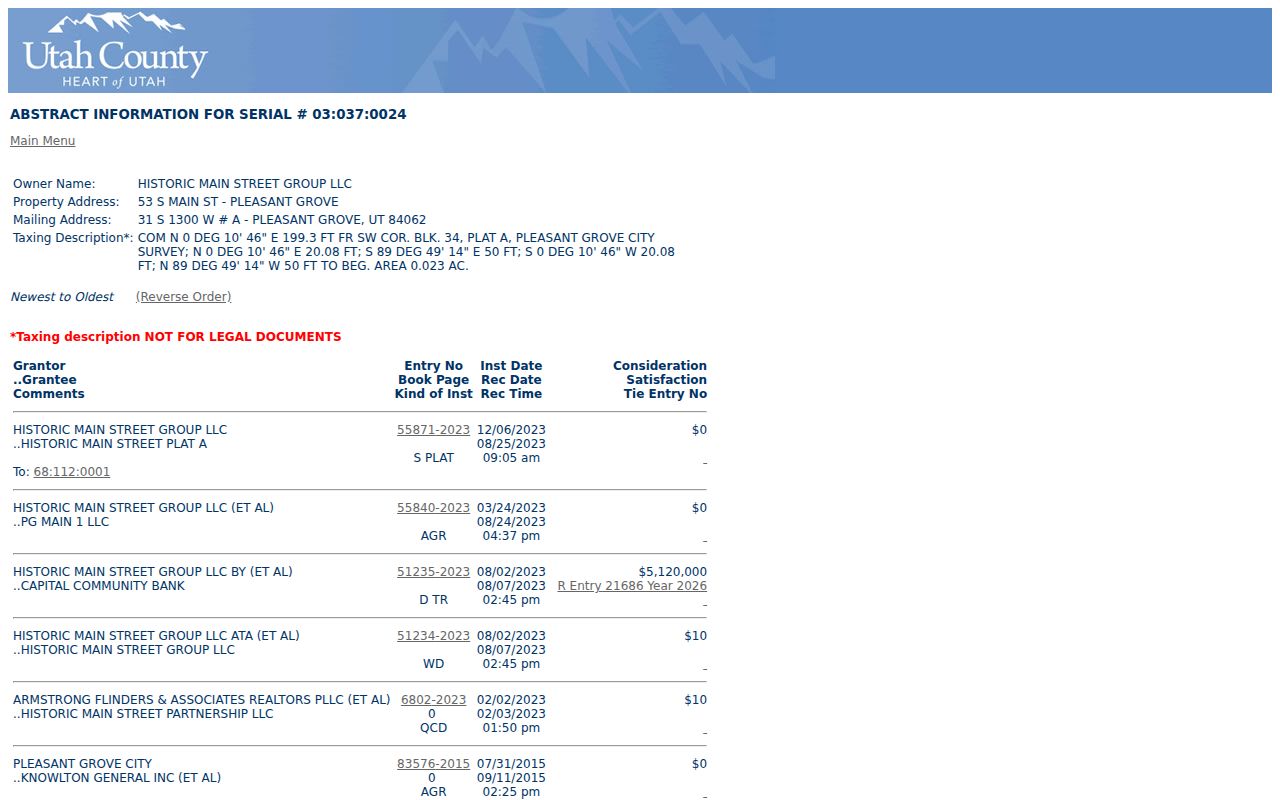
The dated abstract layout shows how a place record can support, but not replace, a household source.
Pleasant Grove Archives Gaps
Utah Archives provides birth and death guides, series information, microfilm and digital routes, and reference help. Birth images and browseable material cover portions of 1905-1924, with an “Ask Us” route for some years. The Archives notes that county collection began in 1898 and statewide health collection in 1905. Older material may be indexed or digitized differently from a modern county portal.
Use a historical record to establish a dated relationship to Pleasant Grove, then keep residence, birth place, informant, cemetery, and address as separate fields. A birth or death record is not a current resident record. A restricted certificate requires OVRS eligibility, identification, proof, and the correct form. A family-history purpose does not bypass the access rule.
The Archives digital birth route is a documented alternative when a deed or directory has reached its limit.
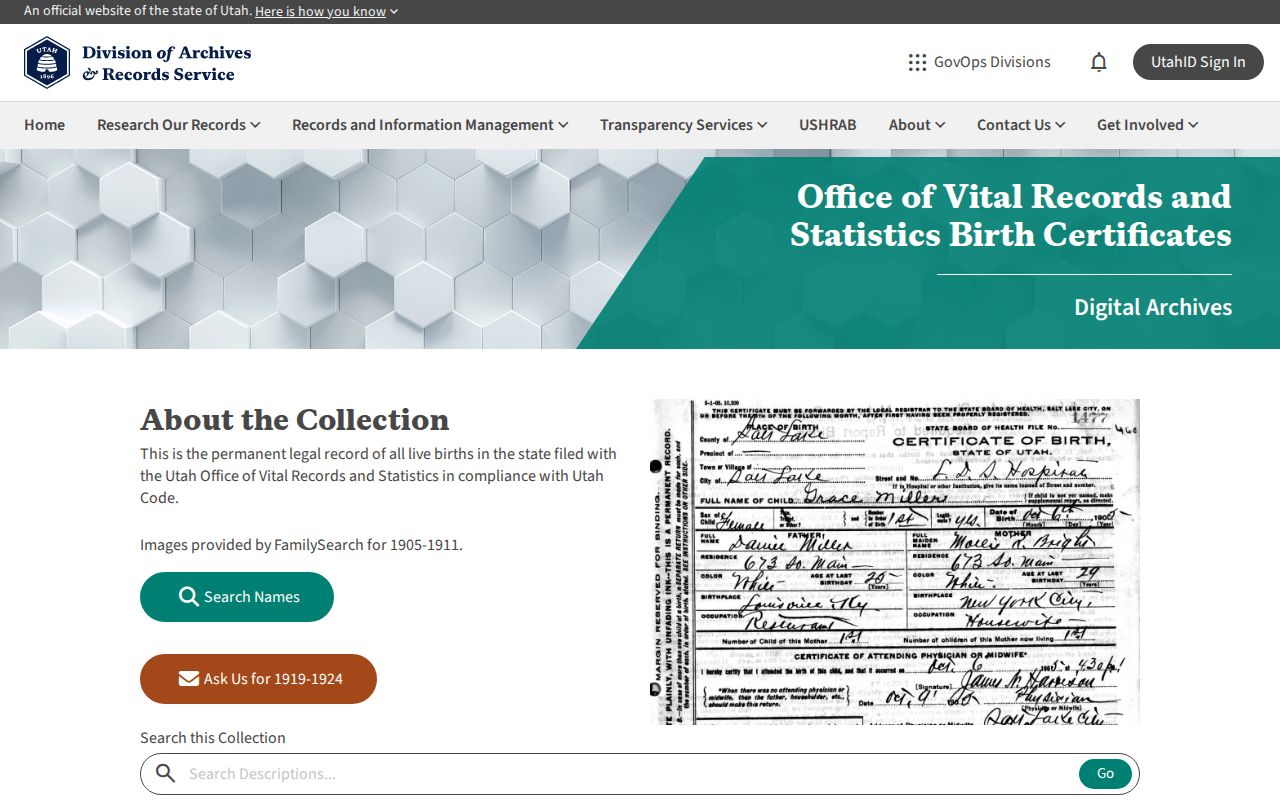
Archive collections can bridge older years, but the series, date, and release rule still belong in the citation.
Past Residents and Privacy
Previous residents research is for house history, genealogy, and a documented property trail. Do not publish full current addresses, birth dates, phone numbers, email, or sensitive case detail. A historical name can still identify a living person. Use “recorded party,” “directory entry,” “published mention,” or “burial record” when those are the actual facts.
Lawful use. Pleasant Grove address history may support personal research and property-record questions. Do not use a past-residents result to track, contact, threaten, or harass a living person.
Safe at Home and voter At-Risk rules exist because an address can create physical danger. A public parcel record does not override those protections. If an online result conflicts with a custodian, preserve the record ID and ask the Recorder, Clerk, court, library, or Archives for the correction or access route.